How to Choose the Best HWID Spoofer and Get Your Game Access Back Fast
· based on the channel clixx
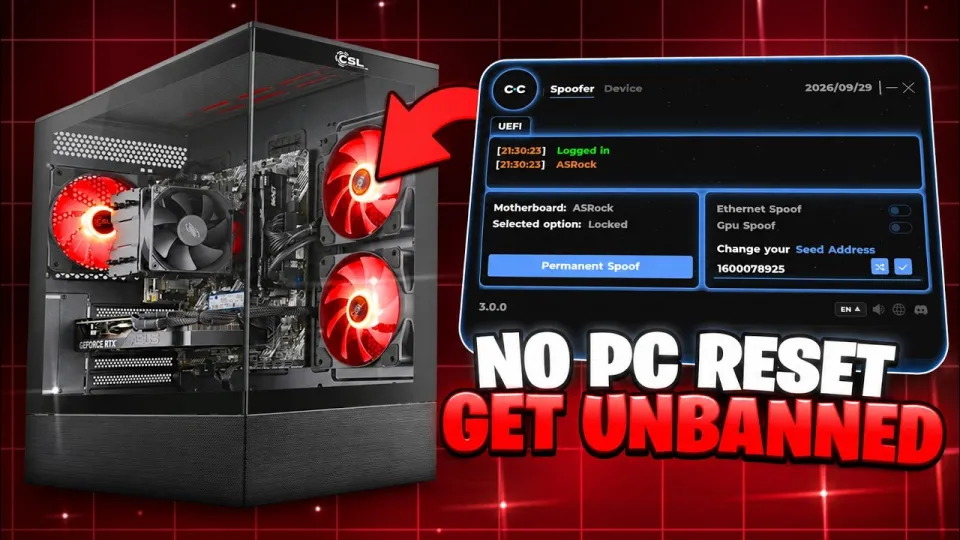
The best HWID spoofer is the one that changes every hardware identifier an anti-cheat system reads, survives a reboot if you need it to, and is updated quickly after each game patch. In practice that means a paid tool with a clear changelog, support for the specific titles you play, and a setup that does not require you to disable Windows security features permanently. A recent walkthrough from the clixx channel goes through one such tool sold on the Ceth Cheats store, covering its interface, configuration options and installation flow.
What an HWID ban actually blocks
When a game issues a hardware ID ban, it stops punishing the account and starts punishing the machine. Anti-cheat clients build a fingerprint from serial numbers and identifiers that Windows exposes, and a match against a ban list is enough to block a new account on the same PC.
The identifiers typically collected include:
- the volume serial number of each drive, including the system disk;
- the SMBIOS data that carries motherboard and BIOS information;
- the Windows machine GUID and product ID;
- the MAC address of the network adapter;
- registry keys tied to the installation and to the game client;
- in some cases, GPU and monitor identifiers and the list of connected drives.
A spoofer works by intercepting or rewriting those values so the fingerprint the anti-cheat reads no longer matches the stored ban. It does not remove the ban from the account, and it does not make cheating undetectable — it only changes what the machine reports about itself.
How the spoofer in the clixx breakdown is set up
The tool shown in the tutorial follows the common pattern for this category of software: a single executable, a small set of configuration toggles, and a reboot or service restart to apply the changes. The video walks through the interface, the available system tools and the installation process itself.
A typical setup sequence looks like this:
- Download the build from the vendor's store rather than a mirror, and check that the version matches the current game patch cycle.
- Create a restore point or note your original identifiers, so you can roll back if a driver update breaks something.
- Disable real-time antivirus protection temporarily — spoofers touch low-level system areas and are frequently flagged as false positives.
- Run the executable as administrator and select the spoofing profile that matches the game you play.
- Apply the changes, then restart the PC so the new identifiers are loaded at boot.
- Launch the game with a fresh account and verify that the hardware ban no longer applies.
The vendor behind the tool in the video offers a 5% discount with the coupon code DENYS, which is worth knowing if you are comparing prices across stores.
Permanent versus temporary spoofing
The single most important choice when comparing tools is whether the spoof is permanent or temporary, because the two behave very differently after a reboot.
A temporary spoof changes identifiers for the current session only. It is useful for testing whether a hardware ban is really what is blocking you, and it is less invasive, but the original values return the moment Windows restarts. A permanent spoof writes the new identifiers into the places the anti-cheat reads at boot, so the machine keeps its new identity across restarts and driver updates until you deliberately revert it. Permanent modes carry more risk: a botched write to disk serials or SMBIOS data can leave a system unstable, which is why a backup step matters.
For most players dealing with a long ban, the permanent option is the one that actually solves the problem; temporary spoofers are better treated as a diagnostic tool.
Which games the tool is advertised for
The store page and the video description list a broad set of competitive titles: Fortnite, Warzone, Rust, CS2, Rainbow Six Siege, Apex Legends and Valorant. That spread matters because anti-cheat coverage is not uniform.
Titles using kernel-level anti-cheat with aggressive hardware fingerprinting — Valorant's Vanguard and Rainbow Six Siege's BattlEye are the usual examples — are the hardest to spoof and the ones where a tool goes out of date fastest. Rust and Apex Legends are also regularly cited in ban discussions, while CS2 and Fortnite sit somewhere in the middle. Before buying any spoofer, check that the vendor publishes updates within days of a major anti-cheat patch; a tool that lists a game but has not been updated for months will not help you.
What to check before you pay for a spoofer
Price is a poor guide in this market, because the expensive options and the cheap ones often use the same techniques. Instead, look at signals that predict whether the tool will still work next month.
- Update cadence. A changelog with recent entries tied to game patches is the strongest indicator of a maintained product.
- Support channel. An active Discord with staff answering setup questions is worth more than a feature list; the tool in the video points users to a dedicated server.
- Refund and reinstall policy. Ask what happens if the spoof fails on your hardware or stops working after a patch.
- Scope of the spoof. Confirm it covers disk serials, SMBIOS and the machine GUID, not just the MAC address, which many anti-cheats no longer rely on alone.
- Clean uninstall. You should be able to restore original identifiers without reinstalling Windows.
Free spoofers circulate widely, but they are the most common source of malware in this niche and rarely survive a single anti-cheat update. If cost is the concern, a coupon on a paid tool is a safer route than a random build from a file host.
Risks and realistic expectations
Spoofing is a cat-and-mouse game, and no tool comes with a guarantee. Anti-cheat developers add new fingerprinting vectors over time, and a method that works today can be detected within weeks. There is also a real technical risk: modifying disk serials, SMBIOS tables or boot-level drivers can cause instability, break Windows activation, or conflict with security software.
It is also worth being clear that a spoofer does not restore a banned account. You still need a new copy of the game, and on titles with strict account-level enforcement, repeat bans can escalate. Treat the tool as a way to reuse your hardware, not as a way to undo a ban.
Links from the video
- Store and product page: https://cethcheats.cc/
- Community and support: https://discord.gg/ceth
Summary
The best HWID spoofer in 2026 is a maintained, paid tool that covers disk serials, SMBIOS and the machine GUID, offers a permanent mode with a clean rollback, and ships updates shortly after anti-cheat patches. The breakdown from the clixx channel shows how one such tool is configured and installed, and which games it claims to support. Use it as a checklist rather than a guarantee: verify the update history, keep a backup of your original identifiers, and remember that the account ban itself stays in place. If you want to test the tool covered in the video, you can get it from the official store and apply the DENYS coupon for 5% off.
Key takeaways
- HWID spoofers replace the hardware identifiers anti-cheat systems use to recognise a banned machine, not the game account itself.
- The breakdown from clixx covers a spoofer sold through cethcheats.cc, with a 5% discount coupon code DENYS.
- Advertised supported titles include Fortnite, Warzone, Rust, CS2, Rainbow Six Siege, Apex Legends and Valorant.
- A spoofer is only useful together with a fresh game account, since the original account ban is not lifted.
- Permanent and temporary spoofing modes differ in whether identifiers stay changed after a reboot.
Source: The Ultimate HWID Spoofer Tutorial 2026 – Full Guide To Get Unbanned Fast · Markdown version
Questions & answers
Does an HWID spoofer unban my game account?
No. A spoofer only changes the hardware identifiers your PC reports, so the anti-cheat no longer recognises the machine as banned. The original account remains banned and you need a new one to play.
Is a free HWID spoofer safe to use?
Risky. Free builds are a common malware vector in this niche and are rarely updated after anti-cheat patches. If you use one, run it in a virtual machine first and never sign in with your main accounts.
How long does HWID spoofing last?
It depends on the mode. A temporary spoof resets when Windows restarts, while a permanent spoof keeps the new identifiers across reboots until you revert it or a game update detects the method.
Which games are hardest to spoof?
Titles with kernel-level anti-cheat and aggressive hardware fingerprinting, such as Valorant with Vanguard and Rainbow Six Siege with BattlEye, are the hardest. Tools for those games need frequent updates to keep working.